logo
Send Message
Shenzhen Ofeixin Technology Co., Ltd
About us
Your Professional & Reliable Partner.
QOGRISYS is professionally committed to providing customers with complete IoT connection solutions.The company focuses on the communication industry. After years of industry market and customer service experience, it has the courage to face extreme technical challenges and help customers solve difficulties. The company has high-quality supporting resources from broadband short-range wireless connection, wide area network cellular communication to deep vertical integration industry, providing ...
Learn More

0

Year Established

0

Million+
Employees

0

Million+
Customers Served

0

Million+
Annual Sales
China Shenzhen Ofeixin Technology Co., Ltd HIGH QUALITY
Trust Seal, Credit Check, RoSH and Supplier Capability Assessment. company has strictly quality control system and professional test lab.
China Shenzhen Ofeixin Technology Co., Ltd DEVELOPMENT
Internal professional design team and advanced machinery workshop. We can cooperate to develop the products you need.
China Shenzhen Ofeixin Technology Co., Ltd MANUFACTURING
Advanced automatic machines, strictly process control system. We can manufacture all the Electrical terminals beyond your demand.
China Shenzhen Ofeixin Technology Co., Ltd 100% SERVICE
Bulk and customized small packaging, FOB, CIF, DDU and DDP. Let us help you find the best solution for all your concerns.

Quality WiFi7 Module & WiFi HaLow Module manufacturer

Find Products That Better Meet Your Requirements.
Cases & News
The Latest Hot Spots.
Say Goodbye to Lag! This High-Tech Module O9201SB Revolutionizes Home Entertainment with a Full-Scale Upgrade!
It’s late at night, and you’re deep into your favorite show when suddenly, the screen freezes into a slideshow. The whole family is fighting for bandwidth, and your game’s latency is skyrocketing. Are these frustrating network issues disrupting your smart home experience? Don’t worry! Qogrisys has developed a cutting-edge module equipped with **Wi-Fi 6 + BT5.4**—O9201SB—that is quietly revolutionizing the set-top box industry with an unparalleled "experience upgrade"! 1. The Pain Points of Home Entertainment: Is Your Set-Top Box Truly "Smart"? With the rise of 4K/8K ultra-high-definition videos, cloud gaming, and smart home devices, home networks are under immense pressure: "One Network, Multiple Devices" Leads to Lag**: When the TV, phone, tablet, and smart speaker are all online, Wi-Fi 4/5 simply can’t keep up!   High-Definition Videos Turn into "Mosaic"**: 8K video requires over 100Mbps bandwidth per second, and traditional modules struggle to deliver.   High Costs of Core Chips**: Customization is complex and expensive, leaving manufacturers frustrated.   2. Introducing O9201SB: Wi-Fi 6 + BT5.4 Redefines "Smooth" 1. Speed Boost: Instant 8K Video Streaming Dual-Band Simultaneous Technology**: 2.4GHz for stable wall penetration, 5GHz for blazing-fast speeds, with 2T2R rates up to 1200Mbps. 8K videos load instantly, with zero buffering when dragging the progress bar! MU-MIMO + OFDMA**: Multiple devices can connect simultaneously without competing for bandwidth. 2. Bluetooth 5.4: Unlocking New Smart Possibilities Bluetooth Remote Control with Instant Response**: Enjoy more sensitive voice control and seamless operation. Connect External Speakers and Game Controllers with Zero Latency**: Dive into a fully immersive gaming and entertainment experience.   3. Leading Technology + High-Level Service: A Win-Win for Manufacturers and Users 1. Self-Reliant and Secure, Ensuring Complete Safety Chips comply with international technical standards, ensuring stability and security. Data encryption + localized servers provide comprehensive privacy protection. 2. Flexible Customization, Rapid Response A professional R&D team supports "deep adaptation," completing customization from design to mass production in just 30 days. An optimized supply chain reduces costs by 20% and shortens delivery cycles by 50%.   4. The Future is Here: Seizing the "Golden Gateway" to Smart Homes For users, O9201SB offers a seamless and smooth experience upgrade. For manufacturers, it’s a powerful tool for reducing costs and increasing efficiency. Set-top boxes equipped with this module can not only become the center of home entertainment but also integrate seamlessly with smart home appliances, transforming into a smart control hub. This positions them to capture the core gateway to the trillion-dollar smart home market!     From "usable" to "excellent," and from technological dependence to technological leadership, the O9201SB module developed by Qogrisys is rewriting the rules of the set-top box industry with its outstanding performance and high-level service. Choosing O9201SB isn’t just choosing a module—it’s choosing a future-oriented "experience revolution."  
O9201UB Current State of the Projector Industry: Wireless Connectivity Pain Points Need Urgent Breakthrough
As smart projectors become increasingly common today, user demands for image quality and functionality are continuously increasing. However, the stability and speed of wireless connectivity have become bottlenecks hindering the upgrade of user experience: · 4K/8K Content Transmission Stuttering: High-resolution videos require extremely high bandwidth, and traditional Wi-Fi modules often suffer from delays and buffering in complex environments. · Severe Interference Among Multi-Devices: When projectors are connected simultaneously with multiple devices such as smartphones, tablets, and speakers, network congestion frequently leads to signal interruptions. · Poor Bluetooth Peripheral Experience: Older protocols suffer from high latency and weak anti-interference capabilities, resulting in unstable connections for wireless speakers, game controllers, and other devices. · Conflict Between Power Consumption and Heat Dissipation: High-speed transmission comes with high power consumption, affecting device battery life and even causing heat dissipation issues.       These pain points are undermining your brand's credibility I. O9201UB Module: The "Wireless Heart" Designed for Projectors QOGRISYS has been deeply involved in wireless communication for 12 years. The Wi-Fi 6 + Bluetooth 5.4 dual-mode module O9201UB is designed with four core advantages to restructure the wireless experience in projection scenarios: 1. Wi-Fi 6 Ultra-Speed Transmission, 4K/8K Smooth and Uninterrupted Infinity · Dual-Band Simaltaneous, Smart Switching: 2.4GHz offers strong wall-penetration capabilities, The speed can be up to 1200Mbps while 5GHz, supporting 2T2R DBAC and 1T1R DBDC mode, allowing simultaneous use of different frequency bands for internet access and screen casting, say goodbye to stuttering. · MU-MIMO + OFDMA Technology: Supports high-speed transmission among multiple devices simultaneously, ensuring stable and smooth projection even when multiple users share the network. · Beamforming Technology: Accurately locates device positions, enhances signal strength dynamically, and eliminates projection dead zones, ensuring full signal coverage whether in the living room or conference   ② Bluetooth 5.4 + Low Latency, "Zero Perception" Audio-Video Synchronization · 2Mbps High-Speed Bluetooth: Wireless speakers/headphones’ latency as low as 28ms (industry average : 50ms), delivering concert-like audio effects with "audio-video synchronization." · AFH Anti-Interference Technology: Automatically avoids congested 2.4G channels, allowing multiple devices (remote control + microphone + speakers) to coexist without interference, enabling "instant response" for voice control. · HCI Technology: Provides an intermediate reserve, compatible across kernel versions; USB interface can also connect to Bluetooth speakers, offering premium voice effects, saving debugging time, and reducing pin usage in PCM interface   ③ Compact Size + Low Power Consumption, Greater Design Freedom · Compact Dimension: Ultra-small size of 15×13×2.3mm, suitable for ultra-thin projector designs, saving internal space. · Smart Power Management: Wi-Fi + Bluetooth collaborative power consumption reduced by 20%, extending built-in battery projector runtime by 1.5 hours, ensuring uninterrupted during outdoor campin   4. Flexible Adaptation, Easy Integration · USB 2.0 Interface: Compatible with mainstream projector models, reducing development costs for manufacturers. · Multiple Certifications: Supports WPA3 encryption, BLE Audio, and other standards, ensuring data security and compatibility. ​​II.Seize the New Blue Ocean of "Wireless Projection" Now! The global smart projector market exceeds $80 billion by 2025, with wireless experience becoming a core decision-making factor for users. Projectors equipped with O9201UB are not just "viewing tools" but also home entertainment hubs, business collaboration centers, and smart home gateways. Home Entertainment Scenarios: Wireless game screen casting: Supports 4K@60fps low-latency transmission, paired with immersive Bluetooth speakers. Smart home integration: Direct Wi-Fi connection to control screens/lights, creating an immersive theater system. Business Office Scenarios: Multi-device wireless screen sharing among multiple-devices:Support demonstrations from multiple terminals, improving meeting efficiency by 50%. Remote collaboration optimization: QoS intelligent bandwidth allocation ensures video conferences stable Educational Scenarios: Online classroom assurance: Anti-interference design ensures 4K courseware display smooth. Interactive teaching support: Bluetooth microphone latency < 30ms, enabling zero-lag teacher-student interaction. III.Choosing O9201UB Means You Gain More Than Just a Module ▶Advanced Technology, Performance Benchmark: Based on IEEE 802.11ax and Bluetooth 5.4 protocols, performance surpasses traditional modules completely. ▶ Service Assurance: 7x24 technical support, providing "module + driver + scenario optimization" comprehensive services. ▶ Ecosystem Collaboration, Expanding Scenarios: Beyond projectors, it can integrate with smart home devices (e.g., lights, screens), helping projectors upgrade into smart control hubs. Conclusion: The Future of Wireless Projection is Defined by You! The O9201UB module, with its core advantages of "fast, stable, and efficient," provides the ultimate wireless connectivity solution for the projector industry. Whether it's the home theater’s ultimate experience or efficient business collaboration, it can be handled easily. QOGRISYS is ready to collaborate with you, driving industry transformation through technological innovation, and making every projector a gateway to "wireless freedom"!
From Chips to Modules: The Power of Ecosystem Partners Behind Wuqi Micro's IPO
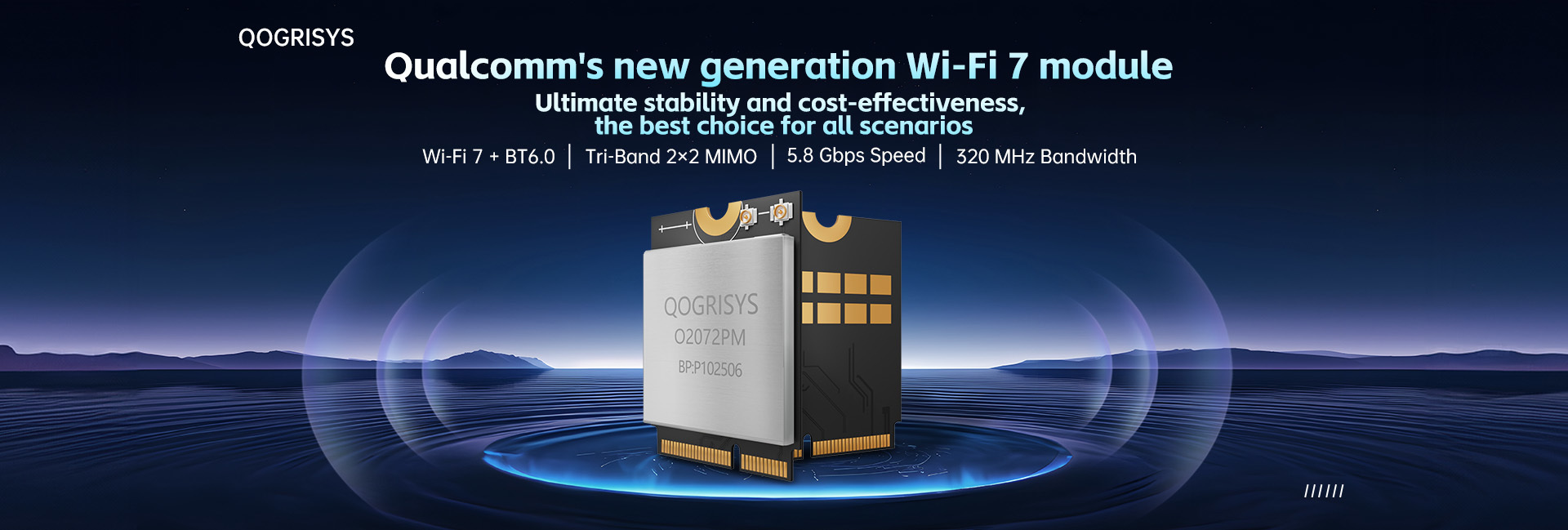
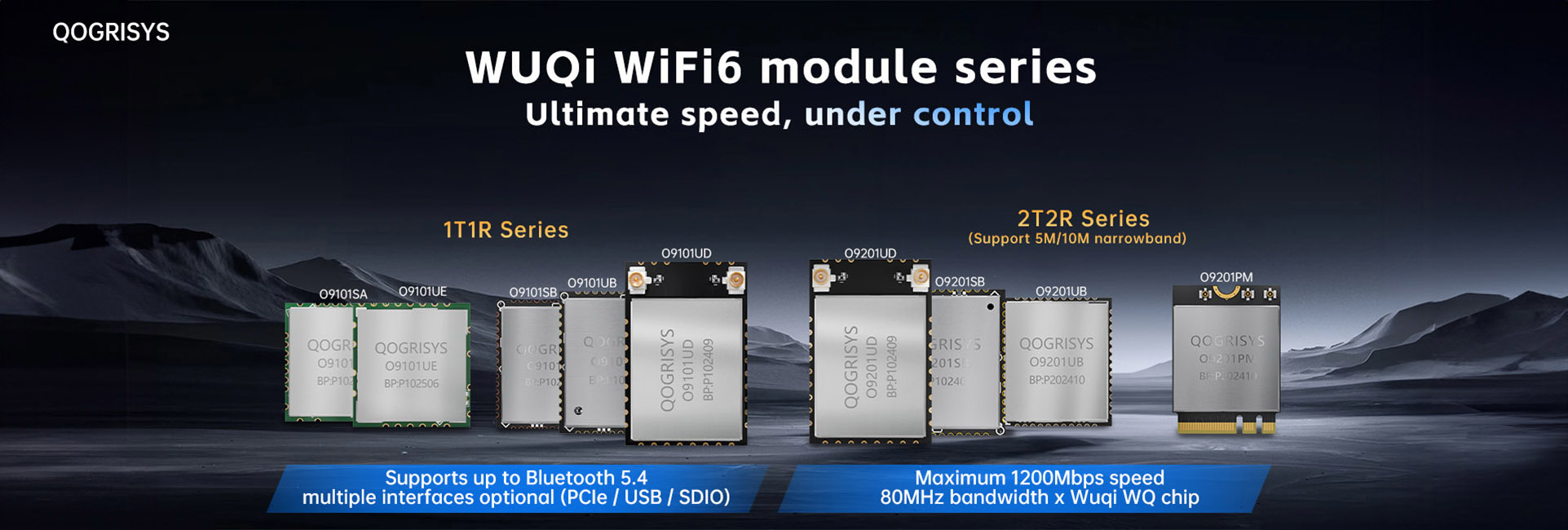
In June 2026, Chongqing Wuqi Microelectronics Co., Ltd.'s IPO application on the Science and Technology Innovation Board was accepted, with a planned fundraising of 1.619 billion yuan. This chip design company, which was one of the earliest in China to fully adopt the RISC-V architecture and achieve commercial mass production, officially stepped onto the stage of the capital market.   For Shenzhen Oufexin Technology, Wuqi Micro is not only a chip supplier, but also a deeply collaborative ecosystem partner. As a professional IoT wireless module solution provider, Oufexin is a key link in transforming Wuqi's chip technology into large-scale commercial solutions. I. Oufexin: A professional module solution provider focusing on the communication connectivity industry Shenzhen QOGRISYS Technology Co., Ltd. was founded in the communications connectivity industry. After years of experience in the industry market and customer service, it has grown into a professional solution provider with high-quality supporting resources ranging from broadband short-range wireless connections and wide area network cellular communications to deep vertical integration of the industry . The company has an annual production capacity of 4,900 KPCS, has served 245 customers, and exports its products to 7 countries . Its service capabilities cover the entire chain from solution design and module R&D to mass production and delivery. Oufexix's role is to enable chip technology to move from "laboratory verification" to "large-scale commercial use," and from "usable" to "easy to use." II. Deep Collaboration with Wuqi Micro: Development of the Full Range of Modules With its stable transmission performance and internationally leading low power consumption, the WQ9201 high-performance Wi-Fi 6 chip from Wuqi stood out from 364 products from 280 chip companies and won the 2024 "China Chip" Excellent Technological Innovation Product Award . Image source: China Chip   As a professional module solution provider, QOGRISYS collaborates closely with QOGRISYS to develop QOGRISYS's full range of modules . Currently released module products include: O9101U E , O9101UD, O9101S A – A series of 1×1 Wi-Fi 6 modules based on the WQ9101 chip from Wuqi. O9201SB, O9201UB , O9201PB , O9201PM , O9201UD , O9201UDH — A series of 2×2 Wi-Fi 6 modules based on the WQ9201 chip . Based on the technology of the Wuqi chip, Oufexin has transformed the high performance of the chip into standardized modules that can be directly integrated and quickly launched through modular design , which greatly reduces the threshold for terminal manufacturers to adopt domestic high-end Wi-Fi solutions. III. Detailed Explanation of Core Product Solutions 3.1 O9201SB: Wi-Fi 6 Module for Set-Top Boxes and Home Audio-Visual Systems a 1200Mbps SDIO 2T2R Wi-Fi 6 + BT 5.4 module developed by Oufexin based on the WQ9201 chip , with a size of only 13×15mm . This module supports all IEEE 802.11 a/b/g/n/ac/ax protocols, dual-band 2.4GHz/5GHz, and DBAC 2×2 MU-MIMO and DBDC 1×1 dual-band concurrent operation . 2.4GHz and 5GHz can operate simultaneously, supporting complete security protocols such as WPA/WPA2/WPA3, WEP, and WAPI, as well as multiple operating modes including P2P GO/GC and STA+AP . The O9201SB has been widely used in set-top boxes, industrial control computers, wireless access points, and other fields . The WQ9201 chip from Wuqi has been adopted in multiple China Mobile set-top boxes, achieving stable mass market supply . Based on this chip, the O9201SB module is quietly sparking an "experience revolution" in the set-top box industry — completely eliminating frustrating experiences such as video stuttering and soaring game latency . 3.2 O9201PM: Wi-Fi 6 Module for Industrial and Embedded Platforms The O9201PM is a 1200Mbps M.2 PCIe 2T2R Wi-Fi 6 + BT 5.4 module , measuring 22×30mm. It uses an M.2 interface and PCIe communication protocol and is mainly targeted at industrial embedded platforms, the Linux/Android open source ecosystem, and domestic SoC solutions . This module is developed based on the Wuqi WQ9201 chip, which integrates multiple high-performance RISC-V CPUs, supports a 2.4GHz/5GHz dual-band architecture and dual-band concurrency, and has achieved several breakthroughs in wireless performance: High-speed dual-band concurrency : Supports 2×2 MIMO and 80MHz bandwidth, with a theoretical speed of up to 1.2Gbps in the 5GHz band, meeting the high bandwidth requirements of industrial data acquisition, high-definition video streaming, and other applications. Superior wall penetration capability : The high-gain iPA design improves signal strength by 30% , making it suitable for complex industrial environments with multiple obstructions, such as factory workshops and warehouses. Low-power architecture : Wi-Fi and Bluetooth work together, reducing power consumption by 40%; deep sleep mode power consumption as low as μA; wake-up response time less than 10ms, suitable for battery-powered portable industrial terminals. Bluetooth 5.4 Full-Power Upgrade : 2Mbps High-Speed Transmission, Latency as Low as 30ms, Supports Bluetooth Low Energy Audio and Mesh Networking The O9201PM has completed driver adaptation and full verification on domestic platforms such as RK3588, Allwinner, and Rockchip. It can be widely used in industrial tablets, edge computing gateways, industrial control equipment, smart retail terminals, digital signage and other scenarios, providing high-performance and high-reliability Wi-Fi 6 connectivity solutions for embedded systems. In industrial manufacturing and IoT scenarios, devices constantly face challenges in wireless environments characterized by multiple obstructions, high interference, and high concurrency . Traditional Wi-Fi solutions often suffer from unstable connections and fluctuating speeds. The O9201PM is a systematic solution addressing these industrial pain points. 3.3 O9201UD/O9201UDH: Long-range Standard/Narrowband Video Transmission Module The O9201 UD/ O9201UD H is a high-power proprietary image transmission module developed by Oufexin based on the WQ9201S / WQ9201HS chip . It supports the 802.11ax Wi-Fi + BLE 5.4 protocol and has a maximum speed of 1200Mbps . This module supports the 5GHz band, with channel bandwidth covering 20MHz/40MHz/80MHz. It supports uplink MU-OFDMA TX and downlink MU-OFDMA RX, and is fully compatible with the Bluetooth 5.4 protocol . Oufexin has been committed to creating high-performance, long-range, low-latency Wi-Fi modules , primarily for applications in high-definition image transmission, drones, multi-connectivity, multi-reliability, and VR/AR scenarios . With advancements in wireless technology, image transmission solutions have evolved from Wi-Fi 5 to Wi-Fi 6. Private image transmission solutions, due to their superior anti-interference and transmission performance, are widely used in drones and are gradually being adopted by terrestrial image transmission solutions such as HDMI/IPC . O9201UD / O9201 UDH module is a prime example of this technological trend, making it an ideal choice for various smart devices and drone image transmission applications. IV. Application Scenarios: From Smart Homes to Industrial Internet of Things Oufexin's module solutions have been widely used in multiple industries: Smart Home : The module fully considers the compatibility of different smart devices, supports multiple communication protocols, and ensures the interconnection of smart home devices. Products such as water purifiers, smart projectors, and smart home appliances can achieve remote monitoring, smart reminders, and data analysis through the Oufexin Wi-Fi module. Digital consumer electronics : The modules provide cost-effective solutions suitable for various consumer electronics products, helping companies control costs and enhance market competitiveness. Smart Cities and Industrial IoT : The module adopts an advanced low-power design, maintaining low energy consumption during long-term operation and extending device battery life. Drones and HD image transmission : The O9201UD /UDH image transmission module provides long-distance, low-latency wireless connectivity for drones, VR/AR and other scenarios . V. Looking to the Future: Wi-Fi 7 and a Broader Connectivity Ecosystem Wuqi Micro plans to raise 1.619 billion yuan in its IPO, which will be mainly invested in the research and development of next-generation Wi-Fi 7 AP chips, edge smart chips, and cutting-edge technology pre-research. Wuqi's technological iteration signifies the continuous upgrading of Oufexin's module solutions. Oufexin has taken the lead in the Wi-Fi 7 arena, launching the O2072PM Wi-Fi 7 module based on the Qualcomm QCC2072. From Wi-Fi 4, Wi-Fi 5, Wi-Fi 6 to Wi-Fi 7, Oufexin has consistently been committed to leading technological trends and providing users with an exceptional wireless experience . With the rapid development of edge AI and edge computing, the requirements for bandwidth, latency, and stability of wireless connections are constantly increasing. Oufexin will continue to serve as a solution and product partner for Wuqi Chip Technology, providing more advanced wireless connectivity module solutions for smart homes, machine vision, industrial IoT, and other scenarios, from Wi-Fi 6 to Wi-Fi 7, and from traditional connections to edge AI. Conclusion The IPO of Wuqi Microelectronics is a landmark event marking the transition of domestically produced high-end Wi-Fi chips from technological breakthroughs to industrialization. Oufexix Technology, as a deep ecosystem partner of Wuqi Microelectronics, is a key force in transforming chip technology into large-scale commercial solutions. From the O9201SB revolutionizing the set-top box industry experience, to the O9201PM redefining wireless connectivity for laptops, and the O9201UD driving the upgrade of drone image transmission technology— behind each module solution lies Ophixin's commitment to its mission of "making good chips into good solutions." The RISC-V architecture has provided a historic opportunity for China's chip industry to leapfrog ahead, while Wi-Fi 7 and edge AI have opened up new market spaces. With deep synergy between chip-level innovation and module-level solution capabilities, the path to independent and controllable domestic wireless connectivity is becoming increasingly broad.  

2026

07/01

Observations from the 2026 Global IoT Conference: A Key Milestone in the Large-Scale Deployment of AIoT, with Communication Modules Taking Center Stage in Industry Value
From June 24th to 26th, 2026, the 2026 Global Internet of Things Conference & Shenzhen International Internet of Things Industry Ecosystem Expo (GIoT) was held as scheduled at the Shenzhen Convention and Exhibition Center (Futian). With an exhibition area of 40,000 square meters , 400 exhibitors, and over 60,000 professional visitors , the event attracted attendees from across China, as well as more than ten countries and regions including the United States, Germany, the United Kingdom, Japan, South Korea, France, the Netherlands, and Australia . The exhibition showcased a complete industry chain, from underlying chips, computing power, and data to upper-level application scenarios . A single core theme ran throughout the entire exhibition: AIoT is moving from proof-of-concept to large-scale deployment, and communication modules, as the core link connecting the physical and digital worlds, are taking center stage in the distribution of industry value. I. Full industry chain coverage: Communication modules occupy a core hub position in the "network layer". GIoT's exhibits are clearly divided into five major sections: underlying sensing technology, communication and network technology, smart terminal hardware, platforms and solutions, and industry collaboration ecosystem . Among these, the communication and network technology section is listed as an independent core section, with exhibits explicitly including 5G/6G communication modules, LPWAN (LoRa/NB-IoT), and edge computing gateways . From a vertical industry chain perspective, GIoT divides its exhibition area into the sensing layer, network layer, platform layer, and application layer —communication modules, located at the network layer, connect upwards to the platform layer for data aggregation and analysis, and downwards to the sensing layer for data acquisition and terminal execution, making them a crucial link in the entire industry chain. What does this mean? For communication module manufacturers, GIoT is not a general exhibition they "casually attend," but rather an industry hub that precisely brings together downstream buyers and application solution providers . The target audience includes system integrators, IT service providers, software developers, and end-user buyers in fields such as smart cities, intelligent transportation, smart grids, smart manufacturing, and smart homes . For communication module suppliers, these are precisely their core target customer groups. II. AIoT Becomes the Main Theme: The Value Leap from "Connectivity" to "Intelligent Connectivity" The most noteworthy trend at this year's exhibition is that the deep integration of AI and IoT has permeated every corner of the event. The exhibition will highlight complete IoT technology solutions across ten application areas , including smart cities, smart security, smart parks/communities, and smart homes . Meanwhile, new AI+ consumer electronics products such as AI glasses, AI PCs, and AI toys, as well as cutting-edge fields like humanoid robots and large-scale model applications, will also be showcased . The concurrent forums further confirmed this trend. During the exhibition, a series of hot topics were discussed, including "Analysis of industry market dynamics and development directions by leaders of well-known IoT companies; Explanation of core IoT technologies by industry experts; Release of new IoT products and technologies; and How to apply 5G technology to the IoT field . " Several professional forums were held concurrently , including the Global IoT Summit, the 5G+AIoT Development Forum, the Artificial Intelligence Technology and Application Summit Forum, and the Industrial IoT Application Summit Forum . As AI moves from the cloud to the edge and from concept to deployment, communication modules are no longer just "data transmission pipes," but key nodes that support edge AI inference and enable local intelligent decision-making. This is the core logic behind the value leap of communication modules. The inclusion of "AI + Ecosystem (chips, computing power, data, edge computing, vision)" as a separate section in the exhibits indicates that the industry consensus has reached on the downward shift of AI capabilities from chips to modules and then to edge computing. III. Market Data Support: The Cellular IoT Module Market is Undergoing Structural Restructuring The exhibition's popularity and the number of exhibitors did not come out of thin air. According to Counterpoint Research's latest Global Cellular IoT Module and Chip Tracker report, global cellular IoT module shipments grew by 4% year-on-year in the first quarter of 2026 . However, the drivers of growth are undergoing structural differentiation. 5G is the fastest-growing cellular technology with a year-on-year growth rate of 39% , mainly benefiting from increased demand for routers/CPEs, connected PCs, and automotive applications. Meanwhile, shipments of 4G Cat 1 bis modules increased by 12% year-on-year , primarily driven by demand for smart meters, POS terminals, asset tracking, and connected vehicle applications in developing markets such as India, the Middle East and Africa, and Latin America. 6% of total cellular IoT module shipments in the first quarter of 2026. Although this proportion is not high, the trend of AI capabilities being pushed down to the module level has been established—from the independent setting of the "AI + Ecosystem" section at exhibitions to the large number of AI consumer electronics products on display, all of these confirm this direction. More noteworthy are the changes on the cost side. Counterpoint predicts that the average selling price of cellular IoT modules will rebound in the second half of 2026 due to rising storage costs, as suppliers will raise module prices to maintain profitability. This upward price trend is expected to gradually extend to entry-level product segments, including Cat 1 and LTE-M. The rebound in ASP signifies that value competition in the module industry is shifting from "price wars" to "value wars" —high-value-added modules that can provide high reliability, multi-protocol integration, and edge AI capabilities will gain the upper hand in the new round of market competition. The full industry chain showcase at GIoT, from communication modules to edge computing gateways, and from AI chips to AIoT platforms, is a concentrated manifestation of this trend. IV. Three Strategic Opportunities for Communication Module Manufacturers from the Perspective of GIoT The signals released by GIoT 2026 are clear enough. For communication module manufacturers, three major strategic opportunities are taking shape: Opportunity 1: Multi-protocol integration capabilities are becoming standard. Single communication protocols can no longer meet the needs of complex scenarios. At the exhibition, a full spectrum of connectivity capabilities was showcased, ranging from the underlying sensing layer (RFID, sensors, positioning technologies (UWB/BeiDou)) to the communication and network layer (5G/6G modules, LPWAN (LoRa/NB-IoT), and edge computing gateways), covering short-range to wide-area applications and from licensed to unlicensed frequency bands . Vendors capable of supporting multiple communication protocols simultaneously on a single module will gain broader application coverage and higher customer loyalty. Opportunity Two: AI Capabilities Descending to Module Levels. As AI glasses, AIPCs, humanoid robots, and large-scale model applications become the focus of the exhibition , communication modules need to handle not only data transmission but also computational tasks such as edge AI inference and local decision-making . The "AI + Ecosystem" section of the exhibits covers the entire chain from chips, computing power, and data to edge computing and vision . The integration of modules and AI is changing from an "optional" to a "must-have." Opportunity Three: Vertical Industry Know-How Becomes Key to Differentiated Competition. The exhibition showcased comprehensive IoT solutions in smart cities, smart security, smart homes, and industrial internet . Suppliers who deeply understand the needs of vertical industries and provide customized module solutions will gain higher customer loyalty and premium pricing power. The target audience included end-user buyers from over 20 sub-sectors, such as smart cities, smart transportation, smart grids, smart manufacturing, smart healthcare, smart parking, smart meters, and smart homes —each sub-sector representing differentiated module needs. In conclusion The 2026 Global Internet of Things Conference and Shenzhen International Internet of Things Industry Ecosystem Expo has concluded, but the industry trends it revealed are only just beginning to take hold. 400 exhibitors, 60,000 professional visitors, and a complete industry chain covering the perception layer to the application layer —behind these figures lies an IoT industry landscape that is rapidly being restructured. As 5G leads the growth of cellular IoT modules with a 39% growth rate, as the AI+ ecosystem rises from a peripheral section of the exhibition to an independent exhibition area, and as communication modules expand from a single link in the "network layer" to a core link connecting the four layers of perception, network, platform, and application—communication modules are moving from a "supporting role in the industry chain" to a "value center . " For those working in the communication module industry, the question they need to answer now is no longer "Will AIoT come?", but rather "When AIoT is deployed on a large scale, are your module solutions ready? "  

2026

06/26

PLC-IoT and Smart Home: A Fundamental Reconstruction from "Connectivity" to "Intelligent Connectivity"
From June 9th to 12th, 2026, the 23rd Guangzhou International Building Electrical Technology Exhibition (GEBT) was held in Guangzhou. At the exhibition, KingPAC showcased for the first time its comprehensive solution for the Internet of Things (IoT) across all scenarios, based on its independently controllable PLC-IoT technology. Its core concept directly addresses industry pain points: no new wiring or complex debugging is required; simply plug it in to have a stable, secure, and intelligent IoT system .   This demonstration sends a clear signal to the industry: PLC-IoT is evolving from an "alternative communication solution" into an "invisible infrastructure" for large-scale commercial deployment of smart homes . I. Underlying Communication Logic: Wires vs. Air Interface To understand why PLC-IoT has become a focal point, we first need to understand its fundamental differences from wireless solutions. Wireless modules (Wi-Fi, Zigbee, Bluetooth Mesh) rely on electromagnetic waves to propagate signals and operate in the 2.4GHz/5GHz frequency band. When the signal passes through walls, it is significantly attenuated when encountering load-bearing concrete walls and metal cabinets; in the unlicensed 2.4GHz band, microwave ovens, neighboring routers, etc., cause serious co-channel interference. PLC-IoT is entirely different. It uses the existing 220V/380V power lines in the home as the data transmission medium , superimposing communication signals in the 0.7–12MHz frequency band . The signal is conducted along the power lines and is not affected by physical obstructions from walls, floors, or metal structures . As long as the circuit is powered, the communication link exists stably . Key conclusion: Wireless modules are limited by signal attenuation and frequency congestion in physical space, while PLC-IoT relies on the physical closed loop of power lines, naturally possessing the fundamental advantage of penetrating walls and being unobstructed. This is the most fundamental and insurmountable structural difference between the two. II. Measured Data: Quantitative Difference in Stability The aforementioned underlying differences are directly reflected in the measured performance. Regarding latency , the PLC-IoT end-to-end response latency is consistently below 50 milliseconds . In a typical three-bedroom apartment, Huawei's solution maintains a response latency consistently below 50ms, with a signal strength standard deviation only one-third that of Wi-Fi solutions . Wireless solutions exhibit greater latency fluctuations, with typical values for Wi-Fi/Zigbee ranging from 100 to 400 milliseconds . In terms of communication success rate , PLC-IoT has a nominal communication success rate of up to 99.99% . In terms of device connectivity , a single PLC-IoT host supports 128–384 device nodes . KingPAC's solution can stably connect over 1000 device nodes per network , supporting more than 15 levels of relays . Wi-Fi typically only supports 30–50 devices . Key findings: In the three core dimensions of latency, success rate, and device capacity, PLC-IoT demonstrates a quantifiable systemic advantage over wireless modules. This is not a "slightly better" advantage, but rather a difference of orders of magnitude. III. Independent Verification of Academic Research The academic research "Research on Smart IoT Application Architecture under the Advantages of PLC-IoT Technology", published in Hebei Industrial Science and Technology in 2024, systematically compared the three technologies . The research results show that home systems using PLC-IoT technology achieve stable long-distance communication, which is impossible with ZigBee technology, reducing costs by approximately 30% compared to KNX technology, and improving the overall system's anti-interference capabilities . The study clearly concludes that PLC-IoT technology is more suitable than ZigBee and KNX technologies for realizing smart homes, building automation, and other intelligent IoT applications . Key findings: Academic research, from an independent third-party perspective, has verified the comprehensive advantages of PLC-IoT over wireless and traditional wired solutions in terms of stability, cost-effectiveness, and anti-interference capabilities. IV. Engineering Advantages: "Network-with-Power" System Eliminates the Need for Wiring Although wireless modules do not require wiring, they face multiple hidden costs in actual projects : large houses require the deployment of multiple Mesh nodes to ensure signal coverage; and the walls of old houses cause severe attenuation of 2.4GHz/5GHz signals. The engineering advantage of PLC-IoT lies in its "no wiring required"—simply install a smart host in the distribution box to achieve whole-house communication coverage through existing wiring . This solves the problem of wireless communication being greatly affected by the surrounding environment, and the elimination of wiring eliminates issues such as the need for separate wiring for industrial fieldbuses, resulting in messy wiring, aging lines, and difficult maintenance. KingPAC's data presented at GEBT 2026 is even more convincing: typical hotel rooms or offices can complete intelligent upgrades in just 2 hours without breaking walls or shutting down operations, reducing the renovation period by 90% . Their solution can directly reuse existing old power lines within the building, without distinguishing between copper or aluminum cores or requiring any rewiring . Key findings: The "no wiring required" feature of wireless modules is often offset by signal coverage issues in practical engineering; the "no wiring required" feature of PLC-IoT is truly "plug and play"—this advantage has decisive commercial value in the existing housing renovation market. V. Network Outage Availability: The Reliability Advantages of Local Deployment The PLC-IoT system is deployed and operates entirely locally—all control logic, scene linkage, and data storage are executed on the local gateway, ensuring full functionality even during network outages . Both Huawei's whole-house smart home system and Haier's smart home system emphasize "uninterrupted connectivity during network outages . " If a purely wireless solution relies on the cloud to execute commands, the devices will lose their ability to operate in the event of a broadband outage . Even though Zigbee 3.0 itself supports local networking, if the manufacturer has not performed offline optimization, it may still be affected by the gateway's network status. Key findings: Local deployment of PLC-IoT enables it to maintain core functions even in network outage scenarios; while cloud-based wireless solutions may be completely paralyzed when the network is out of service. VI. Market Validation: From Industry Consensus to Large-Scale Deployment There is a growing consensus in the industry that as smart homes move from "single-product intelligence" to "whole-house intelligence," and from the "pre-installed market" to "upgrades of existing systems," PLC-IoT, with its underlying advantage of "network access wherever there is electricity," is becoming a key bridge connecting these two markets . Huawei's HarmonyOS Smart Home adopts a triple architecture of "PLC-IoT + StarFlash + Wi-Fi 7," with the PLC utilizing existing wiring to transmit data. Haier Smart Home leads the way with its PLC-based wall-mounted solution, boasting self-produced products across all categories, 3,300 stores, and a decade of dedicated concierge services. Brands like Midea Smart Home have also launched PLC-based post-installation whole-house smart solutions. $11.7 billion in 2025 and is projected to reach $20.9 billion by 2032 , representing a compound annual growth rate of 8.6% . VII. Oufexin Technology: Full-Stack PLC Solutions Empower Industry Implementation As a professional company deeply involved in the field of PLC technology, Shenzhen Qogrisys Technology Co., Ltd. has formed a complete technology matrix in this field, from chip-level modules to full-stack system solutions. S130N-ISI Series – Fully Integrated PLC Module Based on Lianxintong VC6330 The S130N-ISI is a fully integrated power line communication module, internally integrating a 32-bit ARM Cortex-M3 MCU, a 32-bit DSP, embedded Flash, and 1MB SRAM . The module uses an LCC package, featuring an ultra-miniaturized size and compact structure; it integrates an on-chip wire driver, resulting in low power consumption and strong noise immunity . It can be widely used in various PLC real-time communication applications such as smart streetlights, smart homes , central air conditioning, and ubiquitous power IoT terminal devices . 3121N-H Series – Wideband PLC Module Based on HiSilicon Hi3121S The 3121N-H is developed based on the HiSilicon Hi3121S, operating in the 0.5-3.7MHz and 2.5-5.7MHz frequency bands, and its protocol is based on a subset of the IEEE 1901.1 standard. One CCO can connect 200 STAs and supports dynamic routing and automatic multi-path addressing for rapid network setup. Oufexin's PLC module products can be widely used in various PLC instant communication application scenarios such as smart street lights, smart homes , smart parking, central air conditioning, photovoltaic communication, and ubiquitous power Internet of Things terminal equipment. Based on the Hisilicon and Lianxintong dual-chip platforms, the company has formed a complete PLC module product matrix ranging from narrowband to broadband and from hundreds to thousands of nodes. In conclusion The rise of PLC-IoT is not a replacement for wireless solutions, but a structural supplement to the communication infrastructure of smart homes . Behind walls where wireless signals cannot penetrate, in commercial spaces requiring large-scale stable networking, and in existing buildings where rewiring is not feasible, PLCs are becoming that "invisible but indispensable" connection base. For every participant in the smart home and IoT module industry, the question that needs to be answered now is not "Will PLC become mainstream?", but "When PLC-IoT becomes the default communication method for smart homes, is your product ready? " Shenzhen Qogrisys Technology Co., Ltd. specializes in PLC technology. Based on mainstream chip platforms such as HiSilicon Hi3121S and Leadcore VC6330/VC6322TF, it has launched a complete series of PLC module products, including the 3121N-H and S130N-ISI. Learn more about PLC modules and solutions.  

2026

06/25